Support
Float Tilt Level Switch - FTS
- What are the typical applications/ services, FTS is suitable?
It is used for Water, Waste Water, Effluent, Dosing Liquids, Free Flowing Slurry and Sludge in Sewage Treatment Plants, Effluent Tanks and Sumps.
Typical applications involve overflow protection, pump dry run protection and pump on-off control.
- What is material of construction?
The float of the switch is PP and cable is neoprene.
Float is protected with IP68
- How many types of floats are available?
- Obconical/ Biconical Float: Clean and dirty liquids, non-sticky slurry, large tanks, sumps, reservoirs,
- Biconical-Large Float : Clean and dirty liquids, viscous slurry, large tanks, sumps, reservoirs
- Biconical Aseptic Float : Sanitary applications, drinking water, beverages
- Biconical Ex-proof Float : Inflammable liquids, hazardous area
- Minituba Float : Clean and dirty liquids in small tanks and small inlet
- Whether the switch is suitable for hazardous area applications?
No. Standard float tilt switches are not explosion-proof.
There is separate float switch Biconical Ex-Proof (E) available for hazardous area application.
- Whether the switch can be used for multiple level application?
Yes. Using multiple floats, multiple switching set point are achieved.
With single float switch, single switch point is achieved.
- How set points are determined in the switch?
Cable length of the float switch is provided corresponding to switch set point.
- What is the maximum cable length offered for the switch?
From 1 to 30 mtrs (larger lengths on demand)
- What is the maximum temperature and pressure limits?
Max. Temperature – 70 °C
Max Pressure - 3.5 kg/cm2 (Float switch with open ended cable)
1kg/cm2 (Switch assembly with flange connection)
- Does the switch require external power?
No.
- What is minimum specific gravity of liquid for which the float switch is suitable?
The float is suitable for minimum specific gravity of 0.8
- How does the switch work?
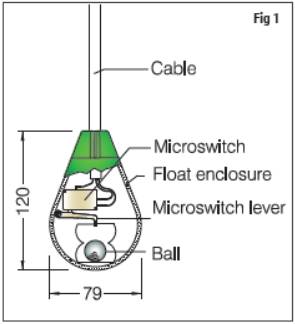
It consists of a float suspended from an open ended cable. A float assembly houses microswitch alongwith a moving steel ball, which slides as float position changes. An adjustable stopper is inserted on float cable which acts as pivot. When the liquid level rises, the float moves up around the adjustable stopper (pivot), causing the steel ball to move and operate the micro switch lever to actuate.
- What is the output of the switch?
The output is changeover of microswitch contacts. The contacts are potential free (dry) (NO/NC) rated for 5A @ 250VAC, which can be used to trigger relays, alarms, or control circuits.
- Whether the switch is available with DPDT contacts?
No. We suggest to use Techtrol Level Controller with switch for DPDT contacts.
- Whether the switch is suitable for turbulent liquid?
Yes.
For moderate turbulent liquid, it is provided with suspended ballast with wire rope and cable tie is tied at appropriate locations for switching set points.
- Whether the pump can be directly operated through the switch?
For higher loads like pumps, use switch contacts alongwith contactor or relay.
- How it is installed on tank?
- It is installed from tank top. For easy installation in outdoor, it is provided with flange connection alongwith terminal enclosure. Insert the float cable through tank opening /nozzle and fix the flange with suitable gasket and nuts & bolts.
- In case of open ended cable, fix the cable with suitable clamp at tank top.
- Refer Installation diagram in catalog.
- Whether switch set points are adjustable on site?
Float cable length is provided according to level set point. However, open ended cable insertion inside the tank can be adjusted according set points.
- What are the precautions need to be taken during installation?
Ensure - Process connection of the switch match with tank connection.
- Float insertion through the nozzle ID.
- In case of open ended cable, terminate cable wire in appropriate weatherproof junction box to protect it from water and dust.
- Float & cable MOC is suitable for service liquid.
- Slurry or sludge is free flowing and not very viscous.
- Mounting of float switch is away from suction
- What information is required to get quotation at earliest?
- Tank Details – tank height/ depth along with nozzle size & length.
- Number of set points and set point levels
- Liquid, its nature (corrosive, suspended particles/slurry)
- Operating Conditions – maximum temperature & pressure, any agitation in tank or turbulence in liquid
- Area classification- Safe or hazardous
All Rights Reserved © 2021 PUNE TECHTROL PRIVATE LIMITED
Engineered by THE IMPALS